History of the Atlantic Cable & Undersea Communications
from the first submarine cable of 1850 to the worldwide fiber optic network
CS
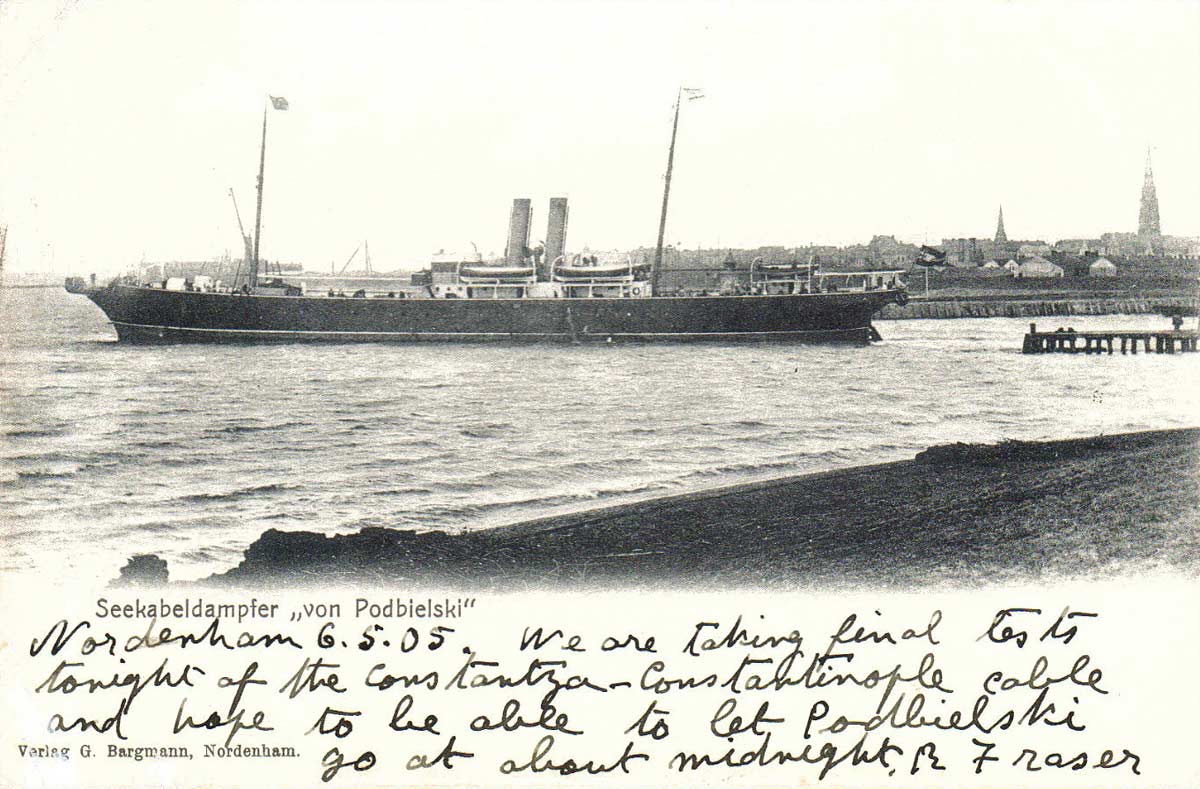
Von Podbielski
by Bill Glover
|
History of the Atlantic Cable & Undersea Communications |
|
CS
Von Podbielski |
|
CS VON PODBIELSKI Built in 1899 by D.J. Dunlop & Company, Port Glasgow Length 265.5 ft Breadth 35.1 ft Depth 22.4 ft Gross tonnage 1494
Designed by the British firm of consulting engineers, Latimer Clark, Forde & Company, for laying and repairing. Built for Norddeutsche Seekabelwerke, coming into service in February 1900. Fitted with three cable tanks with a coiling capacity of 20,500 cubic feet, two bow sheaves and one stern sheave. Johnson & Phillips supplied the cable machinery which consisted of a forward paying out-picking up machine and an aft paying out machine. They also supplied and fitted the bow and stern sheaves. Sold to the Dutch East Indies Government in 1905 and renamed Telegraaf. Broken up in 1914. CABLE WORK
CABLE REPAIRS
CABLE WORK AS TELEGRAAF
|
|||||||||||||||||||||||||
Research Material Needed The Atlantic Cable website is non-commercial, and its mission is to make available on line as much information as possible. You can help - if you have cable material, old or new, please contact me. Cable samples, instruments, documents, brochures, souvenir books, photographs, family stories, all are valuable to researchers and historians. If you have any cable-related items that you could photograph, copy, scan, loan, or sell, please email me: [email protected] —Bill Burns, publisher and webmaster: Atlantic-Cable.com |