|
From Medals of the U.S. Mint, the first century, 1792-1892, by R.W.
Julian.
The
Field medal is singular in nature because it was awarded twice, something
a little out of the ordinary for Congressional medals. Perhaps the
intrepid Field, for all the troubles he had gone through from the elements
and business rivals, deserved more than one medal.
After
the Congressional resolution of March 2, 1867 [see full text below], matters were to move rather
quickly. Joseph Goldsborough Bruff of the Treasury Department, who
prepared the original design, finished it by late July and within a few
days it was on the way to the mint. (He was Supervising Architect
of the Treasury Department at that time.)
Although
Bruff produced a fairly detailed drawing for his design, William Barber,
then an assistant engraver, asked for a sitting with Field in New York
so that the likeness might be as perfect as possible. In September,
1867, Barber went to New York and carefully sketched Field. Barber
returned quickly to the mint and began work on the proper models.
After
Barber's return matters moved with due artistic speed - that is to say,
slow. The models were reduced on the newly-arrive Hill Engraving
Machine, which had just been purchased from an English firm. This
was appropriate, as Field's cable linked Great Britain and the United
States.
The
dies were finished by late in April, 1868, and the first gold medal struck
about two weeks later, after all the lengthy preparations had been made. There was some delay also with respect to a proper case. On May 15th, 1868, the gold medal was sent to the Treasury and received
the next day by Treasury Secretary Hugh McCulloch.
J.J.
Knox, the Comptroller of the Treasury and a numismatist in his own right,
wrote the mint officials that "a slight defect on the knuckle of
the forefinger of the hand holding the wreath" had been found and
needed correction. For some unknown reason the medal was then put
in an obscure Treasury Department safe and forgotten.
By
late in 1868 Field had begun to wonder where his medal was and said as
much to those in a position to find out the reason for the delay.
The Treasury officials could not find the first medal and ordered another
one struck. This was sent to Washington on December 17th, 1868,
and duly presented to Field. The first gold medal seemed to have
vanished.
Suddenly,
in late March or early April, 1874, someone found the first gold medal
and sent it to Philadelphia for melting. Field received news of
his first medal being found, probably through the newspapers, and asked
to have it also. After a jeweler tested the first piece to make
sure it was pure gold, Field paid the government its gold value and received
the first gold medal. The value of the fine gold in the first one
was $553.90 (26.79 ounces).
The
Field medal went on public sale about 1869 or 1870. A number of
aluminum medals were struck in November, 1868, possibly in part for Field
himself.
 |
 |
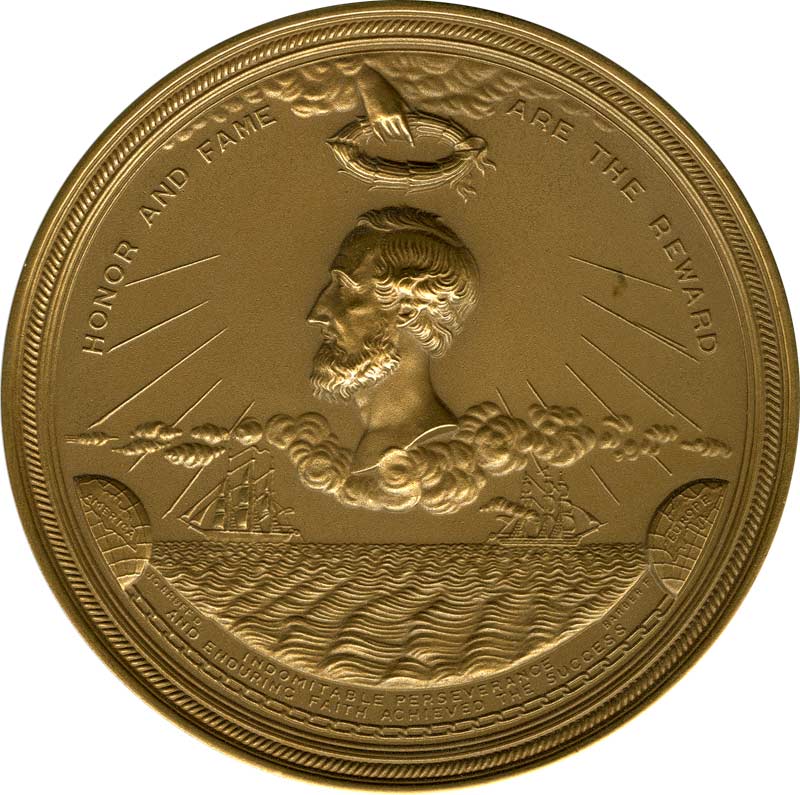
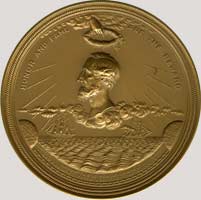
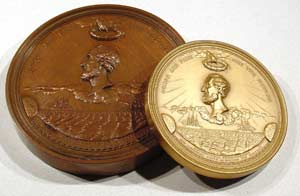
Obverse: Hand issuing from clouds about to
place a laurel wreath on the head of Cyrus Field (to left) itself on a base
of clouds.
HONOR AND FAME ARE THE REWARD above a scene of ships sailing from two partial
globes labelled AMERICA and EUROPE; the two continents are further connected
by a chain at the bottom. Exergual legend INDOMITABLE PERSEVERANCE
AND ENDURING FAITH ACHIEVED THE SUCCESS. In small letters towards
bottom J.G. BRUFF.D. and BARBER F. The whole is surrounded by a border
in the form of a cable. |
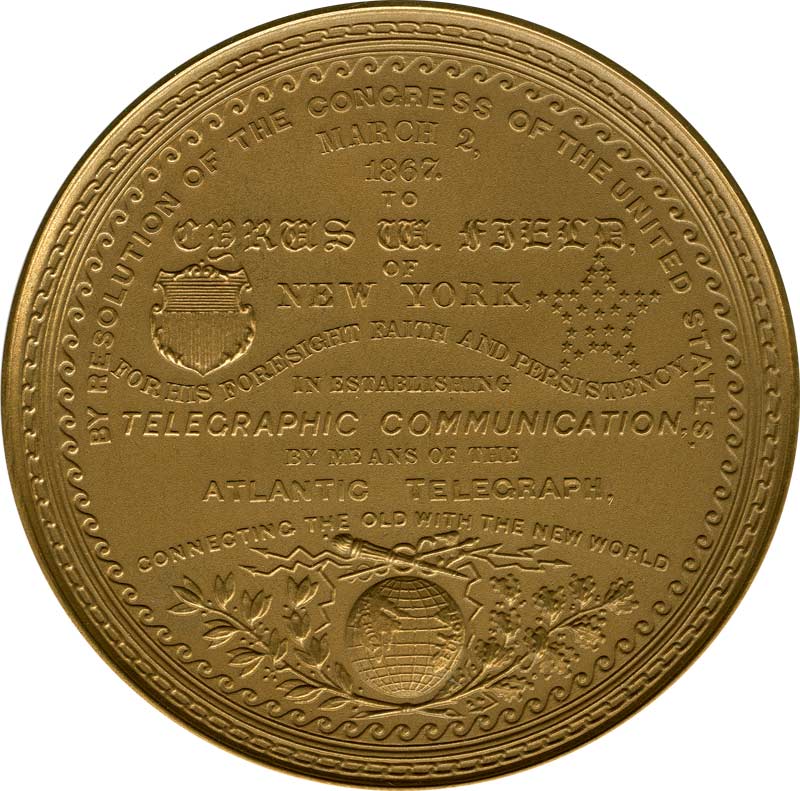
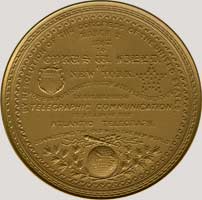
Reverse: Ornate border, American
shield, thirty-one stars in the form of a star, branches, and a globe
labelled EUROPE and AMERICA within and around the legend BY RESOLUTION
OF THE CONGRESS OF THE UNITED STATES above inscription MARCH 2, 1867,
TO CYRUS W. FIELD OF NEW YORK FOR HIS FORESIGHT, FAITH AND PERSISTENCY
IN ESTABLISHING TELEGRAPHIC COMMUNICATION BY MEANS OF THE ATLANTIC TELEGRAPH
CONNECTING THE OLD WITH THE NEW WORLD.
Size 103 mm
Engraver William Barber |
The images are from the bronze
replica (Mint #625) issued by the United States Mint of the gold medal
awarded to Cyrus Field in 1868.
The original medal was 103mm in diameter; the replica is 76mm. See the Medals and Tokens page for further details.
Thanks to the late Rich Hartzog of World
Exonumia for supplying the historical information on the medal. |
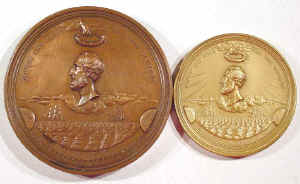
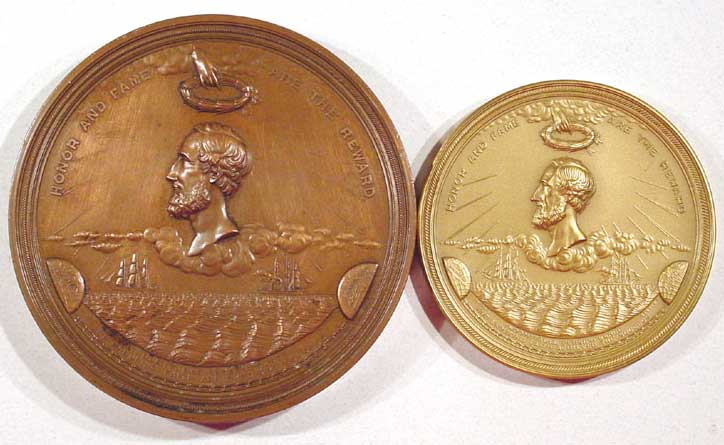
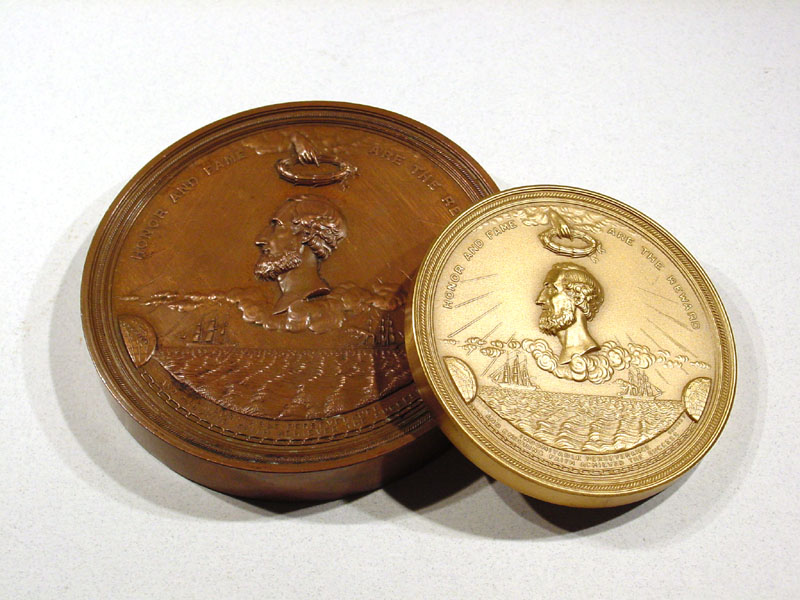
Randy Cole shares this photograph of his
103mm bronze replica of the Field medal, shown with the 76mm version for
comparison. The larger medal is 14mm thick, about twice the thickness of
the 76mm medal.
Randy also maintains a website
on the Vibroplex series of telegraph keys. |
Senate Consideration of the Joint Resolution:
[The Congressional Globe, March 2, 1867]
Mr. Morgan. I move that the Senate proceed to the consideration of Senate joint resolution No. 148, presenting the thanks of Congress to Cyrus W. Field.
The motion was agreed to; and the Senate, as in Committee of the Whole, proceeded to consider the joint resolution. It proposes to present the thanks of Congress to Cyrus W. Field of New York, for his foresight, courage, and determination in establishing telegraphic communication by means of the Atlantic cable, traversing mid-ocean and connecting the Old World with the New, and requests the President of the United States to cause a gold medal to be struck, with suitable emblems, devices, and inscriptions, to be presented to Mr. Field. When the medal shall have been struck, the President is to cause a copy of this joint resolution to be engrossed on parchment, and transmit the same, together with the medal, to Mr. Field, to be presented to him in the name of the people of States of America.
Mr. Morgan. When this joint resolution was favorably reported from the Committee on Foreign Relations I did not anticipate that there would be any serious objection to it, and I still trust there will be no objection to its passage in this or in the other branch of Congress.
The telegraphic cable lies concealed from public view somewhere upon the bed of the Atlantic ocean yet the fact of its existence, of its perfect and complete success, and that it is now in constant daily and hourly use by the people of this country and by the people of all other countries is known throughout the civilized world.
Every member of this body, as he reads his morning newspaper, finds chronicled there the most important events that have occurred on the previous day all over the continent of Europe. The Government of the United States have used it and used it with effect, not frequently, because the appropriations annually made by Congress for this purpose are not large enough to admit of the frequent use of the Atlantic telegraph. Nevertheless, it has been used advantageously by the Government. John H. Surratt was arrested upon information conveyed through the Atlantic cable. By means of it also negotiations were suspended which were being conducted by a representative of this Government with a representative of a foreign Power, that, if consummated, would scarcely have met the approval of either the Government or people of the United States. So, too, when the Government of France changed its purpose in relation to the period for withdrawing the French troops from Mexico the telegraphic cable was used to make known to the French Emperor the dissatisfaction it would occasion to the Government and people of this country if the proposed change should be made.
All these matters are well known to the Senate and to the country. I hope it is equally well known to the Senate and to the country as it is to me that Cyrus W. Field, a citizen of New York, has been the prime mover in this enterprise from first to last.
I do not say that Mr. Field alone is entitled to all the credit; but I wish to be understood as expressing an opinion, which is largely shared by the whole country, that but for Field and Mr. C. M. Lampson, a merchant of London, and who is also a native of the United States, the enterprise would have failed. Mr. Lampson was exceedingly liberal in contributing to the cable company from his own private fortune a very large amount of funds, and he rendered still greater service in influencing others to subscribe to the object, which he was enabled to do on account of his high social and commercial standing. The Government of Great Britain has made Mr. Lampson a baronet, which is regarded as a mark of great distinction by the people of all monarchical Governments; and it is now left to the Government and people of the United States to take whatever measures they deem fit in recognition of the much greater part which was borne by one of their own citizens.
I will not trespass upon the Senate longer than to read a brief extract from the remarks made by the president of the Chamber of Commerce on the occasion of a recent banquet given to Mr. Field. On that occasion Mr. Low said:
“It was the office of Mr. Cyrus W. Field to organize and combine all the forces that were requisite to conduct this enterprise from its inception to the final and glorious issue. To it he devoted twelve years of his life, all his energy, and all his fortune. Fort times he crossed the Atlantic ocean for its sake; an as captain, now Sir James Anderson, in a recent letter, says: . . He worked hard and sacrificed the repose of his home and the repose of every one else who could bear influence on his darling scheme.' I venture to say there is not an emotion known to the human soul, whether of joy or sorrow, of pleasure or pain, of disappointment following high-wrought expectation, of anxiety bordering on despair, of hope mounting to the religion of sublimest faith, that during these twelve last years has not entered into the experience of our long-tried and well-proved champion.”
By the passage of the joint resolution Congress will record its appreciation of the exertions and sacrifices made by Mr. Field in conducting to a successful result, the greatest enterprise of the age, and which a distinguished member of the British Parliament has declared to be second only in importance to the discovery of the art of printing. By it also we mark the era of this great event, and establish in the most enduring form the paternity of the measure as belonging to a citizen of the United States, and we give encouragement and assurance to all of our enterprising countrymen, virtually saying to them that if they are faithful and endure to the end in laboring for the highest achievements of science and art, when successful, their toils; sufferings, and sacrifices shall not pass unnoticed and unrewarded.
Mr. Sumner. I rejoice in every enterprise by which human industry is quickened and distant places are brought near together. In ancient days the builders of roads were treated with exalted honor. I offer them my homage now. The enterprise which is to complete the railroad connection between the Pacific and the Atlantic belongs to this class. But I believe that it is not so peculiar and exceptional as that which has connected the two continents by a telegraphic wire. It is not so historic. It is not in itself so great an epoch. It is difficult to exaggerate the difficulty or the value of this new achievement which it is now proposed to honor.
The enterprise was original in its beginning and in every stage of its completion. It began by a telegraph line connecting St. John's, the most easterly port of America, with the main continent. This was planned by a few gentlemen at the house of Cyrus W. Field, among whom were Peter Cooper, Moses Taylor, Mar. shall O. Roberts, and David Dudley Field. New York and St. John's are twelve hundred miles apart. When they were brought into telegraphic association the first link was made in the chain destined to bind the two continents together. Out of this American beginning sprang those efforts which ended in the oceanic cable.
In other respects our country led the way. The first soundings across the Atlantic were made by American officers in American ships. The United States ship Dolphin first discovered the telegraphic plateau as early as 1853, and the United States ship Arctic sounded across from Newfoundland to Ireland in 1856, a year before her Majesty's ship Cyclops sailed the same course.
It was not until 1856 that this American enterprise showed itself in England, where it was carried by Mr. Field. Through his energies the Atlantic Telegraphic Company was organized in London, with a board of directors composed of English bankers and merchants, among whom was an American citizen, George Peabody. By conjoint exertions of the two countries the cable was stretched from continent to continent in 1858. Messages of good will traversed it. The United States and England seemed to be near together, while President and Queen interchanged salutations. Then suddenly the electric current ceased and the cable became a lifeless line. The enterprise itself hardly lived. But it was again quickened into being, and finally carried to a successful close. British capital contributed largely to this result, and the society had for its president an eminent Englishman, the Right Honorable James. Stuart Wortley; but our countryman, Mr. Field, was the mainspring. His confidence never ceased; his energies never flagged. Twelve years of life and more than forty voyages across the Atlantic were woven into this work. It is not too much to say that he was the Alpha and the Omega of a triumph which has few parallels in history.
Englishmen who took an active part in this enterprise have received recognition and honor from the sovereign. Some have been knighted; others have been advanced in service. Meanwhile Cyrus W. Field, who did so much, has remained unnoticed by our Government. He has been honored by the popular voice; but it remains for Congress to embody this voice in a national testimonial. If it be said that there is no precedent for such a vote as that proposed, then do I reply that his case is without precedent, and it belongs to you to make a precedent by this expression of national gratitude. Thanks are given for victories in war. Give them now for a victory of peace.
The joint resolution was reported to the Senate without amendment, ordered to be engrossed for a third reading, read the third time, and passed.
The text of the Congressional
Resolution:
Saturday,
2 March 1867
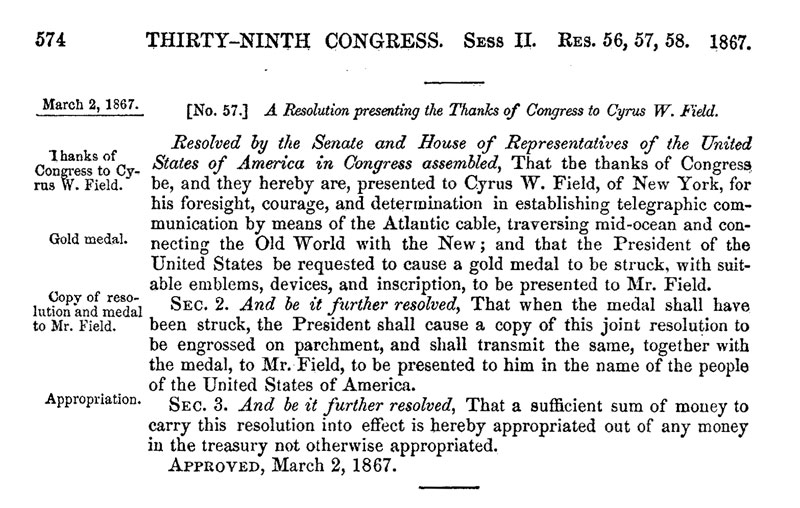
A Resolution
presenting the Thanks of Congress to Cyrus W. Field.
Resolved
by the Senate and House of Representatives of the United States of America
in Congress assembled, That the thanks of Congress be, and they hereby
are, presented to Cyrus W. Field, of New York, for his foresight, courage,
and determination in establishing telegraphic communication by means of
the Atlantic cable, traversing mid-ocean and connecting the Old World
with the New; and that the President of the United States be requested
to cause a gold medal to be struck, with suitable emblems, devices, and
inscription, to be presented to Mr. Field.
SEC. 2. And
be it further resolved, That when the medal shall have been struck,
the President shall cause a copy of this joint resolution to be engrossed
on parchment, and shall transmit the same, together with the medal, to
Mr. Field, to be presented to him in the name of the people of the United
States of America.
SEC. 3. And
be it further resolved, That a sufficient sum of money to carry this
resolution into effect is hereby appropriated out of any money in the
treasury not otherwise appropriated.
14 Stat.
574
In Britain, Punch was rather less complimentary:
The Electric Medal
The American Parliament has passed a resolution of thanks to Mr Cyrus Field, for having made the Electric Telegraph between England and the States, and has ordered a Gold medal to be struck, in honour of Mr Field’s single-handed feat. This is quite right. Punch would be the last man to deny that “alone Field did it”. We are not quite sure whether he let the water into the space called the Atlantic Ocean, but we know that he invented electricity and telegraphy, and after years of solitary experiments, perfected the Cable which is now laid. He carried it in his own one-horse gig from Greenwich to Ireland, and having previously constructed the machinery for paying it out, launched the Great Eastern by his unaided efforts, lifted the rope on board, and consigned it to the deep with his own hands. Mr Field tied on the Newfoundland end with great neatness, and then ran on with the continuation, and never sat down, nor even blew his nose, until he despatched the first message. Therefore, the medal is his, and the reverse also. But in concession to the ignorant prejudices of the world, might not just the most modest space, say the rim, bear in faint letters the names of Gisborne, Glass, Elliot, Anderson, Canning, and one or two more, who stood by, with their hands in their pockets, and saw the smart Cyrus perform the Herculean task. Anyhow, we do give the ground on which this end of the Cable rests. But we would not press the request, if it would hurt American feelings.
[Punch, March 16,1867]
Here is the official record of the transmission of the replacement medal to Cyrus Field, taken from Executive Documents Printed by Order of the House of Representatives during the Third Session of the Fortieth Congress 1868-69:
40th Congress, 3d Session. | House of Representatives | Ex. Doc. No. 89.
GOLD MEDAL PRESENTED TO CYRUS W. FIELD.
MESSAGE
FROM THE
PRESIDENT OF THE UNITED STATES,
IN RELATION TO
The gold medal presented to Mr. Cyrus W. Field.
February 18. 1869.—Referred to the Committee on Foreign Affairs and ordered to be printed.
To the Senate and House of Representatives:
I transmit to Congress a report from the Secretary of State, with accompanying documents, in relation to the gold medal presented to Mr. Cyrus W. Field, pursuant to the resolution of Congress of March 2, 1867.
ANDREW JOHNSON.
Washington, February 17, 1869.
DEPARTMENT OF STATE,
Washington, February 17, 1869.
The undersigned, Secretary of State, has the honor to lay before the President, with a view to its transmission to Congress, the accompanying copy of a correspondence in relation to the gold medal presented to Mr. Cyrus W. Field in the name of the people of the United States, pursuant to the resolution of Congress of March 2, 1867. Respectfully submitted.
WILLIAM H. SEWARD.
DEPARTMENT OF STATE,
Washington, January 21, 1869.
SIR: With this you will receive a letter addressed to Mr. Cyrus W. Field, which is intended to accompany a box containing a medal and a packet containing an engrossed copy of a congressional resolution, which, bearing the address of Mr. Field, have been sent to you to-day by Harnden's Express. You will take an early occasion to place the enclosed letter and its accompaniments in the hands of Mr. Field, and inform the department of their delivery.
I am, sir, your obedient servant,
F.W. SEWARD.
J.C. Derby, Esq.,
United States Despatch Agent, New York.
DEPARTMENT OF STATE,
Washington, January 7, 1869.
SIR: Pursuant to the resolution of Congress of March 2, 1867, the President has caused to be prepared, for presentation to you, in the name of the people of the United States, a gold medal, with suitable devices and inscriptions, in acknowledgment of your eminent services in the establishment of telegraphic communication, by means of the Atlantic cable, between the Old World and the New.
This testimonial, together with an engrossed copy of the resolution referred to, is herewith transmitted to you by direction of the President. I am, sir, your obedient servant,
WILLIAM H. SEWARD.
Cyrus W. Field, Esq., &c., &c., New York.
OFFICE OF THE UNITED STATES DESPATCH AGENCY,
New York, January 22, 1869.
SIR: Your favor of the 21st was received this morning, as also the medal and roll for Mr. Field. I regret to say that Mr. Field sailed for Europe in the Cuba on Wednesday last. I have them deposited in my safe, and await your further instructions.
I would suggest their deposit, until Mr. Field's return, in the "Safe Deposit Company" of this city.
Your obedient servant,
J. C. DERBY,
United States Despatch Agent.
Hon. F. W. Seward,
Assistant Secretary of State.
DEPARTMENT OF STATE,
Washington, January 23, 1869.
SIR : Your note of yesterday has been received. In reply, I have to state that no objection is perceived to your making such disposition of the medal, &c., as you propose, until the return of Mr. Field from Europe.
I am, sir, your obedient servant,
WILLIAM H. SEWARD.
J. C. Derby, Esq.,
United States Despatch Agent, New York.
OFFICE OF THE UNITED STATES DESPATCH AGENCY,
50 Dunne Street, New York, February 5, 1869.
SIR: I beg to enclose a copy of a cable telegram received from Mr. Cyrus W. Field, giving instructions about the disposition of the medal and resolutions of Congress. I have delivered the same to his daughter, and her receipt for the same is attached. Yours, very truly,
J. C. DERBY,
United States Despatch Agent.
Hon. William H. Seward,
Secretary of State.
145 Broadway, New York,
February 2, 1869.
Dear Sir: I make the following extract from a telegram received from London to-day, and remain,
Yours, very respectfully,
HENRY H. WARD.
J.C. Derby, Esq.,
United States Despatch Agency.
Request Mr. Derby to please deliver the gold medal and documents from the Secretary of State to my daughter Grace.
CYRUS W. FIELD.
RECEIPT.
Received from J.C. Derby, esq., the gold medal and resolutions from Congress.
GRACE FIELD.
February 4.
|