History of the Atlantic Cable & Undersea Communications
from the first submarine cable of 1850 to the worldwide fiber optic network
CS Mackay Bennett
by Bill Glover
|
History of the Atlantic Cable & Undersea Communications |
CS Mackay Bennett |
|
|
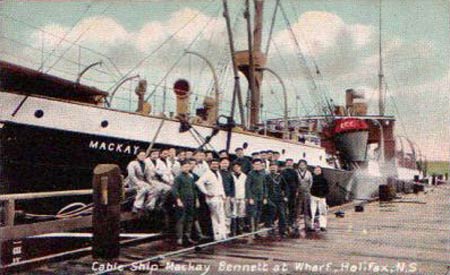
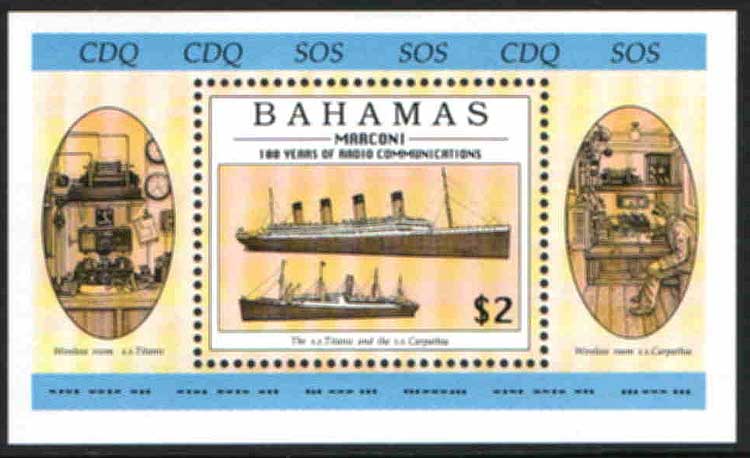
CS MACKAY BENNETT AND THE TITANIC Following the loss of the Titanic in April 1912 the White Star Line chartered four ships, of which two were cable ships, CS Mackay Bennett, owned by the Commercial Cable Company and CS Minia owned by the Anglo American Telegraph Company but operated by Western Union. All those recovered were brought to the Mackay Bennett where if it was possible they were identified and all personal possessions were removed and stored safely. Those identified as first class passengers were placed in wooden coffins which were stored aft while third class passengers and crew were wrapped in canvas and placed for'rd. In all 328 bodies were recovered including one child. It was thought at the time that this was Gösto Leonard Paulson, the youngest of four sons travelling with their mother Alma Paulson. Of the remainder 119 were buried at sea of which 60 were unidentified and the remaining 209 were taken to Halifax. The seventy five members of the crew of the Mackay Bennett adopted the child, paying for his funeral and headstone. He was one of forty-four unknown victims buried in the Fairview Lawn Cemetery. In 2001 attempts to identify some of the victims using DNA analysis were undertaken, but only that of the child succeeded. It was established then that he was Eino Viljami Panula aged 13 months, from Finland, one of five children travelling with their mother Marie. However, a re-analysis of the DNA in 2008 using more advanced techniques has revealed that this initial conclusion was incorrect, and the child is now believed with 98% certainty to be Sidney Leslie Goodwin.
See the Commercial Cable Company page for more information on the Mackay Bennett. The Encyclopedia Titanica has a transcript of the diary of Frederick Hamilton (Cable Engineer: Mackay Bennett).
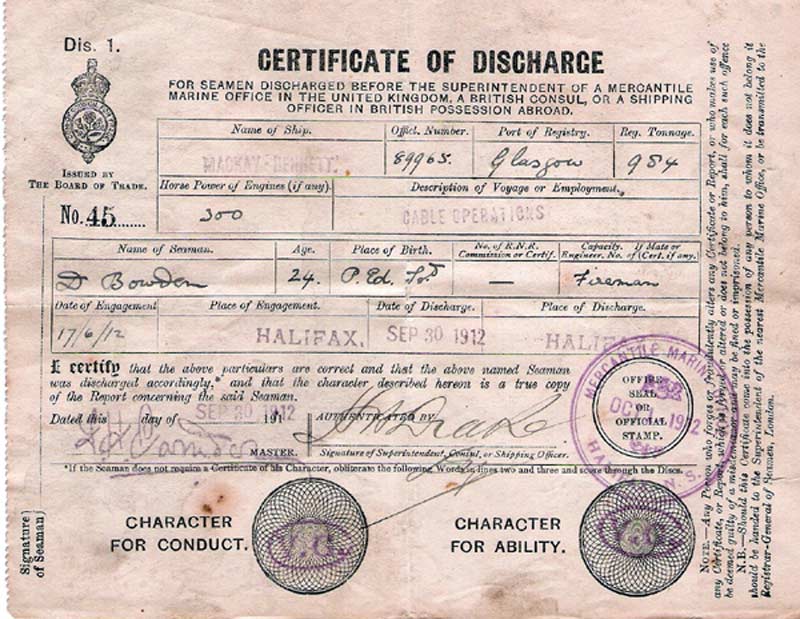
Site visitor Don Cunningham’s grandfather Daniel Bowden served as a fireman on the Mackay Bennett for many years and was a crew member when the ship helped recover bodies from the sinking of the Titanic. Don’s great-uncle, Gavin Naismith, was the 2nd Engineer on the Mackay-Bennett during that time, and his paternal grandfather, Ludovic Cunningham, was 2nd Engineer aboard CS Minia at the time of the Halifax Explosion at the French Cable Wharf in December 1917. Don has his grandfather's Certificates of Discharge issued between 1909 and 1919; a sample is shown here.
CABLE WORK
|
|||||||
|
Last revised: 20 December, 2020 |
|