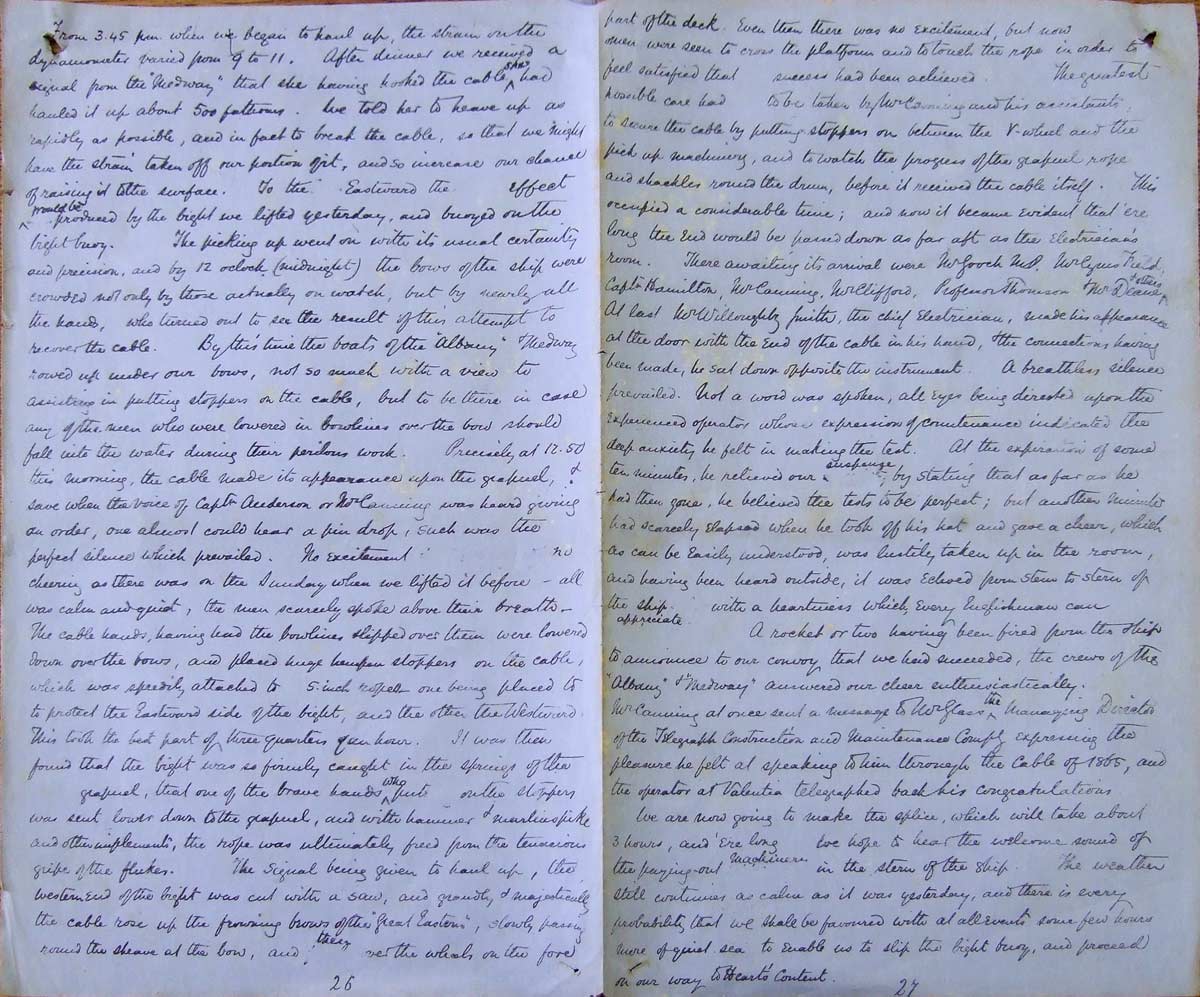
As was often the case on large passenger ships (even as early as the mid 19th century), the Great Eastern had a print shop on board to keep the passengers informed and entertained during a long voyage. But on the 1865 and 1866 cable expeditions the output of the print shop was a little more extensive and diversified than might have been found on a passenger voyage. It also achieved a publishing first: As the cable was being laid, live news from Europe was relayed over the cable to the Great Eastern and was printed in the shipboard newspapers.
In 1865 there were five issues of The Atlantic Telegraph with reports on the cable laying and world news. 1866 had a musical play entitled A Field Glass (performed on July 4th on the voyage from Sheerness to Ireland), followed by two July issues of The Great Eastern Telegraph and Test Room Chronicle published during the expedition, and a third and final issue on September 8th at Heart’s Content. The last document published during the voyage that year was the script for Contentina, a ‘Comic Operetta’ performed on September 17th.
For further details on these and other publications from 1865/66, including the day-by-day diaries of each expedition, see below.
The cable staff all knew each other well from the long preparatory work on the projects each year, and the shipboard publications reflected this with humour and banter. Cable engineer Willoughby Smith, in his 1891 book The Rise and Extension of Submarine Telegraphy, reproduced the text and illustrations of most of these publications, omitting only one issue of The Great Eastern Telegraph and Test Room Chronicle from 1866.
The five issues of the 1865 newspaper have various credit lines such as “Published and Printed by Day on board the Great Eastern.” Illustrations were by Henry O’Neil and Robert Dudley. The 1866 publications have no printing credit, but illustrations were again by Dudley.
| The Great Eastern Telegraph
and Test Room Chronicle 1866 |
 |
 |
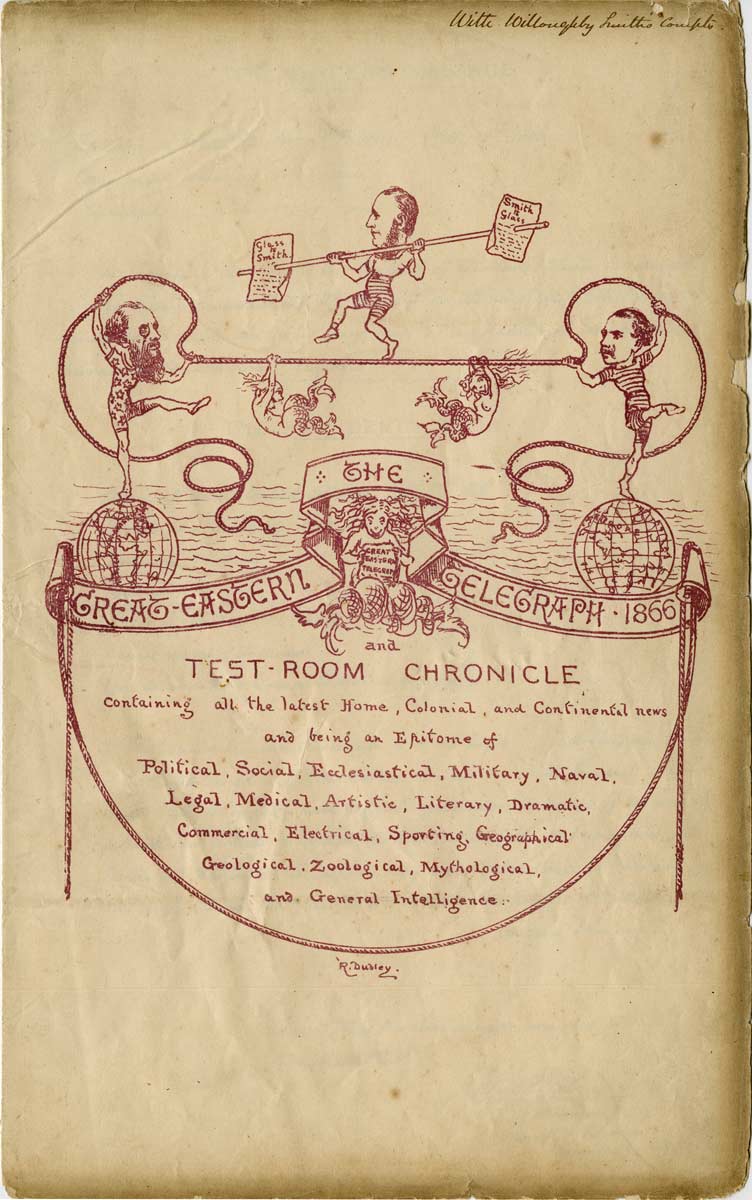
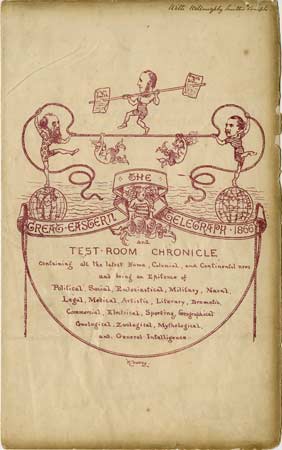
Cover by Robert Dudley and sample page of
The Great Eastern Telegraph
and Test-Room Chronicle
The handwritten note at the top of the cover reads:
“With Willoughby Smith’s Compts.”
Images courtesy of Bill Holly |
Day and Son, the largest firm of lithographers in Britain at the time, were the publishers (under contract to the Atlantic Telegraph Company) of the book on the 1865 expedition written by William Russell and illustrated with lithographs after the paintings made on board ship by Robert Dudley. From the credits above, the firm also provided the printing facilities on board Great Eastern that year, and perhaps in 1866 as well.
The special correspondent of the Daily News, J.C. Parkinson, took a boat out to Great Eastern when the ship returned to Sheerness, and these notes on the printing arrangements for the 1865 cable expedition are extracted from his story published in the paper’s issue of 21 August 1865:
The Atlantic Telegraph
(From our Special Correspondent)
On Board the Great Eastern, Off Sheerness, Sunday
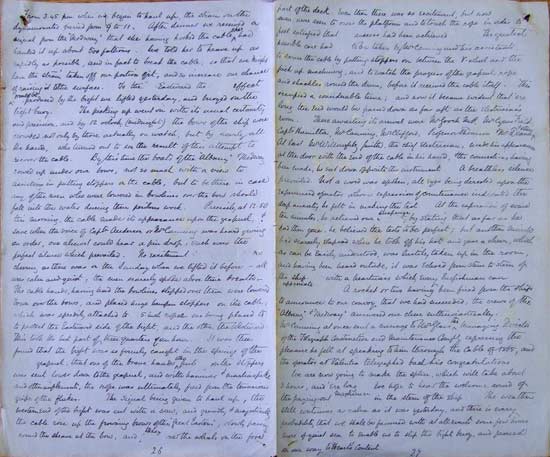
The business-like system observed in recording the events of each day is worthy of note. A lithographic workman, with stone and press, had one of the ordinary ship’s cabins given up to him. Every morning the diary of the preceding day was written by Dr. Russell, and copied by Mr. John C. Deane. The clip was then lithographed and a hundred copies struck off. Meanwhile envelopes addressed to the editors of 25 American journals, and to the editors of 65 published in England, Scotland, and Ireland, were kept in readiness, and as each day’s news was told off it was added to the stock already folded for posting. By this means the letters were sent off simultaneously, and without a moment’s unnecessary delay. The Terrible took the American bag, and would forward it from Newfoundland, and as on the rough day on which she parted company with the Great Eastern it was impossible to keep her boat alongside while the final sheet of diary was being lithographed, all the letters but one were sealed without it, Dr. Russell writing to the agent of the Associated Press at New York, to telegraph the last part of the news to the 24 journals unsupplied.
Nor was this the only use of the lithographer. With a population of 500 souls it would have been impossible, without some system, to keep everyone on board properly posted up on the latest news of the cable, the number of miles paid out, and the number run. A form was, however, drawn out and signed by Mr. Canning, which was lithographed and a number struck off, with blank spaces for the figures. This bulletin was issued every day, and stuck up in a conspicuous part of the deck, informing all of the position of the ship and the quantity of cable run.
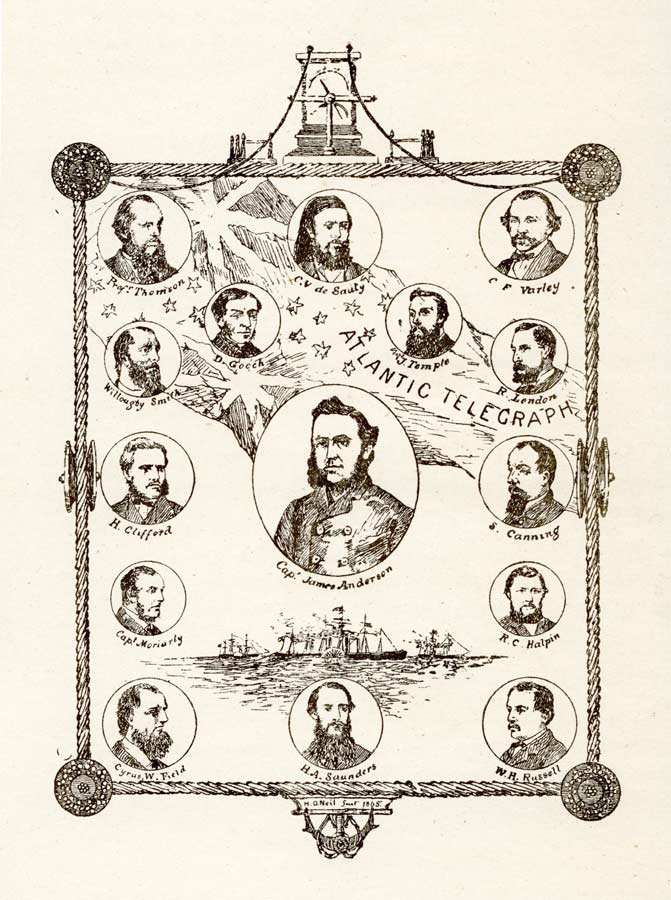
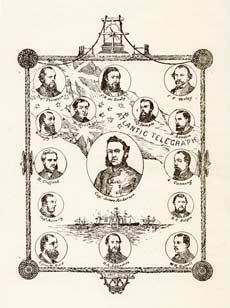
A publication of more magnitude, as well as with higher literary and artistic pretension, was also issued every week from the lithographic press. The Atlantic Telegraph, edited by Mr. Henry O’Neil, A.R.A. illustrated by Mr. R. Dudley and the editor, is probably the most highly finished production ever published at sea. Printed on fine paper, and with illustrations that may vie with the most successful of our pictorial periodicals, this playful record of some of the incidents of the voyage is both interesting and amusing now. The frontispiece consists of portraits of the principal people employed in the expedition. The Atlantic Telegraph flag, with its combination of stars and union jack, floats in the background, the Great Eastern and her guard of honour are in the front, and the whole is enclosed in a neat framework of cable, with sectional cuttings at its four corners. |
Mechanics Magazine had a more detailed description of the printing facilities and procedures, including a slightly different version of some of the text above, in its issue of 25 August 1865:
ATLANTIC CABLE GOSSIP
...
In France, Mr. Russell’s account of the voyage of the “Great Eastern” with the Atlantic cable has given so great an interest to the enterprise that most of the French papers have begun the translation of his log.
Literature was not neglected in the big ship during the expedition, a lithographer being specially retained on board. His duty it was to lithograph and print the previous day’s diary of events, as written by Mr. Russell and copied out by Mr. J.C. Deane. Envelopes addressed to the editors of twenty-five American journals, and to the editors of sixty-five published in England, Scotland, and Ireland, were kept in readiness, and as each day’s news was told off it was added to the stock already folded for posting. By this means the letters were sent off simultaneously, and without a moment’s unnecessary delay. The “Terrible” took the American bag, and would forward it from Newfoundland.
A form, showing the number of miles paid out and the number run, was drawn out and signed by Mr. Canning, which was also lithographed and a number struck off, with blank spaces for the figures. This bulletin was issued every day, and stuck up in a conspicuous part of the deck, informing all of the position of the ship and the quantity of cable run.
Cover by Henry O’Neil
for
the 1865 ship’s newspaper
The Atlantic Telegraph |
Nor was this all; a publication of high literary and artistic pretensions was issued every week from the lithographic press. From inspection we are able to pronounce the Atlantic Telegraph, edited by Mr. Henry O’Neil, A.R.A., illustrated by Mr. R. Dudley and the editor, to be the most highly-finished production ever published at sea. The frontispiece is composed of well-executed portraits of the leading men engaged in the expedition: the Atlantic telegraph flag, with its combination of stars and union jack, floats in the background; the “Great Eastern” and her guard of honour are in the front, and the whole is enclosed in a neat framework of cable. The sketches are full of humour, especially one by Mr. Dudley, of Mr. Cyrus Field taking his turn of duty as watchman in the tank. Under the head of “Births” we find the following:— “August 2nd. On board the ‘Great Eastern,’ Sir Optimus Cable; his unfortunate father dying at the same moment.” “On the 8th inst., Mr. Varley of a Formula, stillborn.” The last page is occupied by a song entitled “The buoy I left behind me,” air “The girl I left behind me;” a portrait of the said buoy being prefixed. |
Of the printing methods used on board ship in the 19th century, Steven Roberts writes:
There were several autographic and anastatic processes around in the 1850s and 60s. They used used a special paper with a glazed surface on which you wrote or drew with a special ink; a lithographer then transferred the image to stone or zinc by pressure and took off copies. As well as handwriting they could reproduce line drawings.
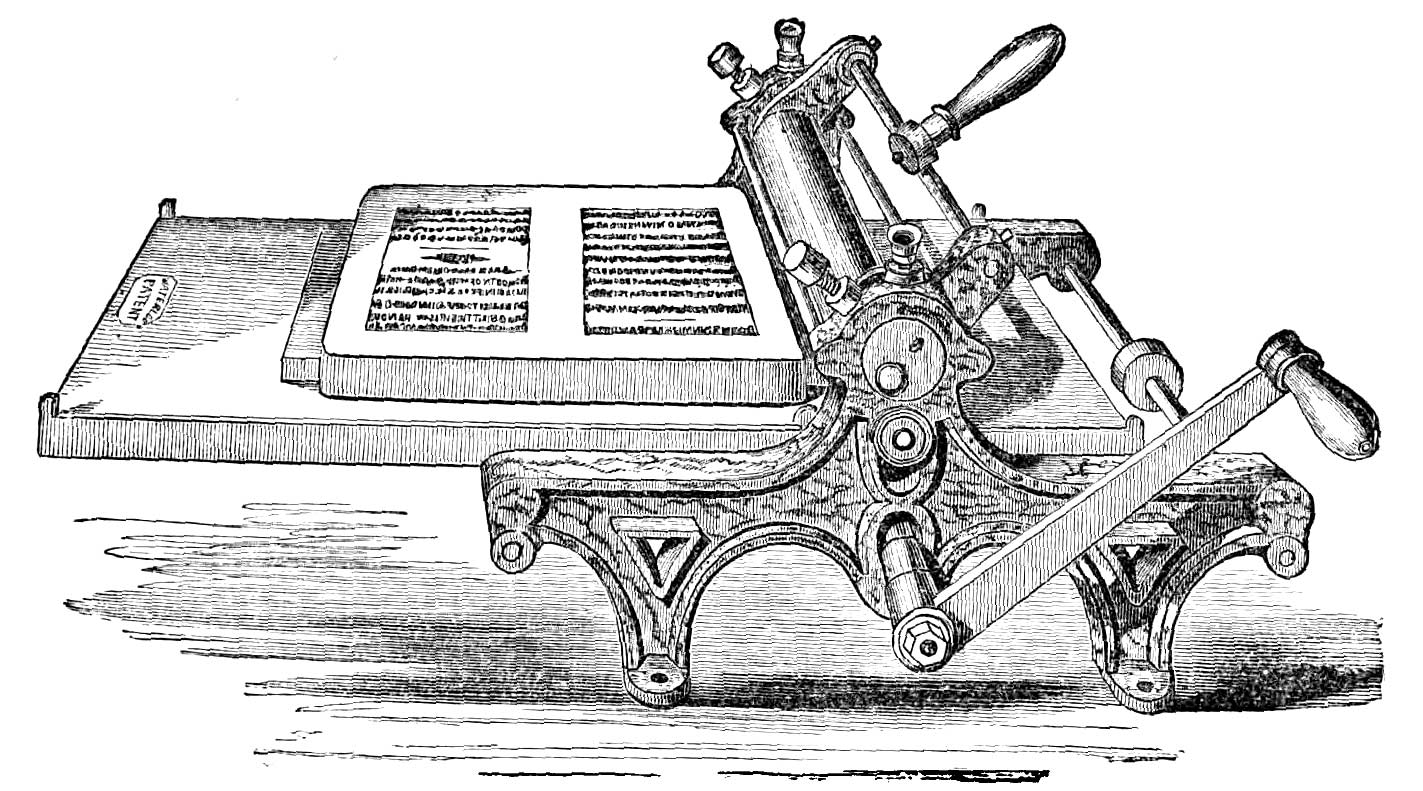
Waterlow Lithographic Press |
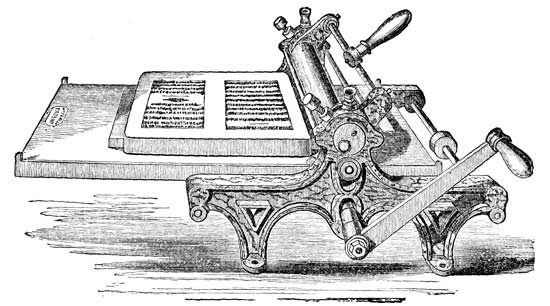
Shown is an engraving of a small “office-sized” lithographic press sold in London in 1855 by Waterlow & Son. According to their ad:
“Nearly One Thousand of these Presses have now been sold, and are being successfully used in all Her Majesty’s Government Offices, Public and Private Schools, Railway Companies, Assurance Offices, and also by the most influential Bankers, Merchants, Clergymen, &c., in the United Kingdom.”
Further details of Waterlow’s lithographic presses may be seen on this page.
I think that Waterlow were the largest makers / distributors of small litho presses in the UK.
As you can see it really is a “desk-top” model. These were used for “duplicating” letters and for printing some sorts of office stationery, and would obviously have been suitable for ship-borne use. The art was in preparing the stone or the zinc plate for printing.
There were specialist “lithographic writers” who had mastered writing in reverse on the stone, or more commonly, by the 1850s, writing on the shiny autographic paper with oily ink as described above. This “offset” method of making the lithographic image allowed the original image to be “right-reading,” and avoided the need to learn reverse writing. A similar process is used in modern photo offset lithography.
The charge in London for providing autographic paper and ink, “working the stone,” supplying paper, and “striking off” 50 folio copies in 1872 was less than ten shillings. The Cunard and India ships had small litho presses for their ship newspapers; no doubt the Great Eastern had one as well.
Waterlow & Son, who were lithographic printers as well as press-makers, introduced the private telegraph to London between their office in the City and their works in 1858. Waterlow’s printed telegraph stamps for Bonelli’s, the Electric, and the Universal Private companies, and somewhat later, most of the Eastern Telegraph Company’s telegram forms and envelopes. The firm was later a major supplier of printing to the GPO, including postage stamps and promotional posters.
Document printed on board Great Eastern, 1866
|
Shipboard Publications
1865
Great Eastern left Ireland on July 29th and the expedition was abandoned on August 11th after the failure to recover the broken cable. The ship stopped briefly in Ireland on August 17th and arrived at Sheerness on August 19th.
William Russell kept a diary of the 1865 expedition which was printed on board ship. At the time of the loss of the cable and the subsequent abandonment of the expedition, the manuscript had 34 pages covering the period up to August 9th, and when Terrible and Great Eastern parted company on August 11th, 25 copies of this version were carried by Terrible to Newfoundland for distribution to the North American newspapers which Russell had contracted with. This version was published on August 27th/28th by those papers.
Meanwhile, as Great Eastern was sailing back to Ireland, Russell finished compiling the final pages of the diary for British distribution, for a total of 37 pages with 65 copies. In addition there was a six-page “Notice to the Reader & Printer,” with corrections to pages 1 through 33, and a single-page “Postscript for Printer and Reader,” with corrections to pages 33 to 35. This version of the manuscript was published in The Times on August 19th.
Five issues of The Atlantic Telegraph were published: Saturday July 29th, Wednesday August 2nd (shortly before the cable broke), Saturday August 12th (the day after the recovery attempt was abandoned), Thursday August 17th (just before the arrival of the ship in Ireland), and an undated issue with illustrations by Robert Dudley and the words to a parody sung by Samuel Canning, “The Buoy I Left Behind Me,” the last item in the bound volume of that year’s publications.
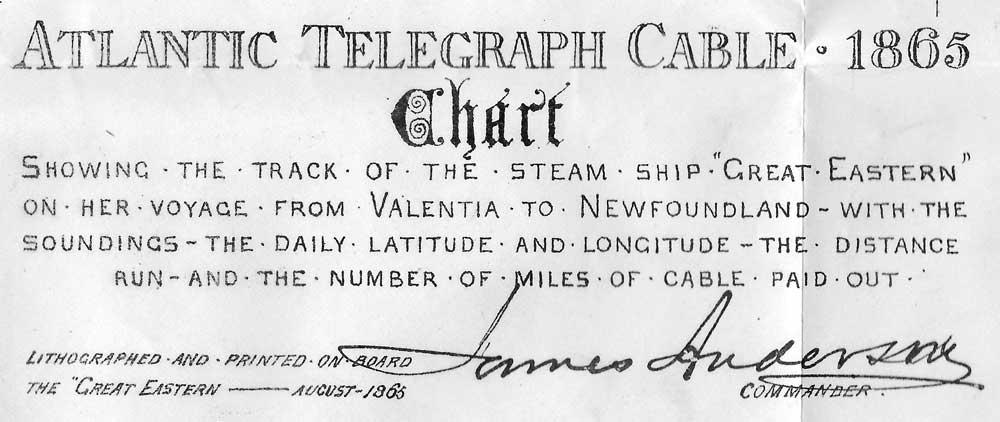
Additionally, two charts were printed on board Great Eastern in 1865. The first measures 13" x 32" and is titled as follows:
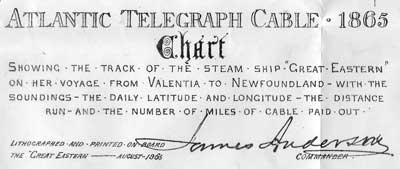
Image of the title from a copy of the chart in the Caroline Moldridge archive of James Stuart-Wortley’s papers
|
Atlantic Telegraph Cable 1865
Chart
Showing the Track of the Steamship “Great Eastern” on her Voyage from Valentia to Newfoundland ~ With the Soundings ~ The Daily Latitude and Longitude ~ The Distance Run ~ And the Number of Miles Paid Out
Lithographed and Printed on Board
the "Great Eastern" ~~~ August 1865
(signed) James Anderson
Commander |
The line of the chart stops on August 2nd, with this note: "Cable parted 3 times hooked again with grapnel, each time the grapnel gear breaking"
This chart would have been too large to fit on Great Eastern’s lithographic press, so it was printed on two of the standard sheets, 15½" and 16½" wide, which were then pasted together.
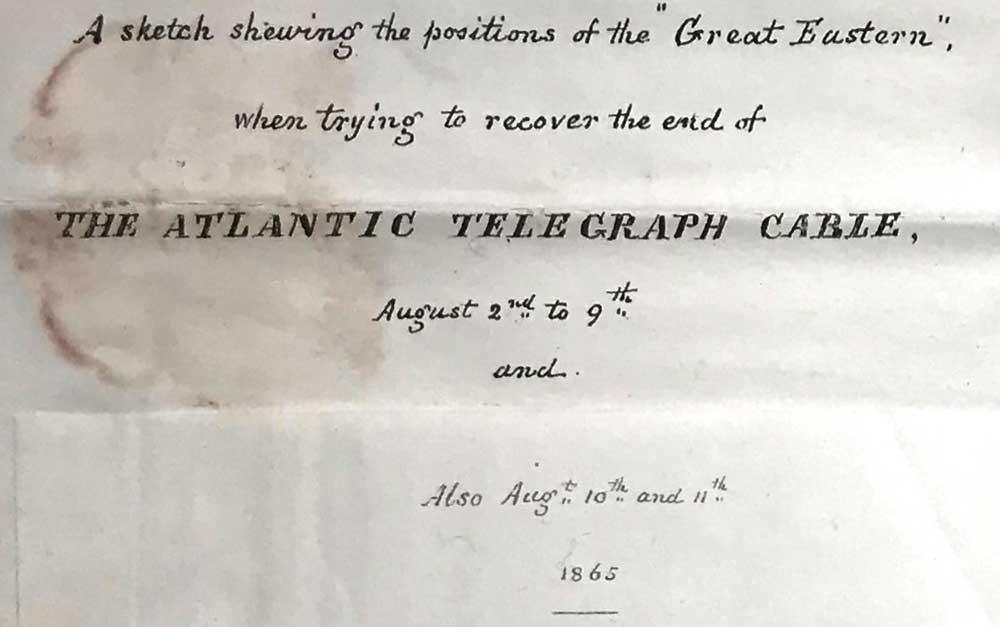
The attempts to retrieve the cable were documented by Henry Moriarty, and a detailed chart was printed on a standard 13" x 16½" sheet. This was evidently printed immediately after the grappling attempts of August 2nd to 9th, as a hinged overlay was added to show the attempts of August 10th and 11th.
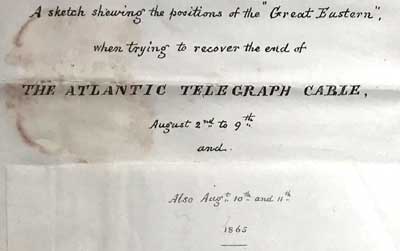
Image of the title from a copy of the chart in the Caroline Moldridge archive of James Stuart-Wortley’s papers
|
A sketch shewing the positions of the “Great Eastern”
when trying to recover the end of
THE ATLANTIC TELEGRAPH CABLE
August 2nd to 9th
and
Also Augt. 10th and 11th
1865
|
After the expedition returned to England, both charts were published in John C. Deane's article in Macmillan’s Magazine in September 1865.
Towards the end of 1865, Day & Son published Anderson’s chart combined with Moriarty’s chart as one of the illustrations in William Russell’s book on the Atlantic Telegraph. A copy of this version is at the National Maritime Museum, Greenwich.
The last document printed on board Great Eastern was Samuel Canning's 21-page private report on the expedition to the Directors of the Telegraph Construction & Maintenance Company. This was datelined Sheerness, 22 August 1865, the ship having moored there on returning to England. Further details in the listing below.
1866:
Great Eastern sailed from Ireland on July 13th and landed the cable at Heart’s Content on July 28th. The ships of the expedition then spent most of August and the first week in September in recovering and completing the lost 1865 cable, landing it at Newfoundland on September 7th. Great Eastern set sail for Liverpool on September 9th and arrived there on the 19th.
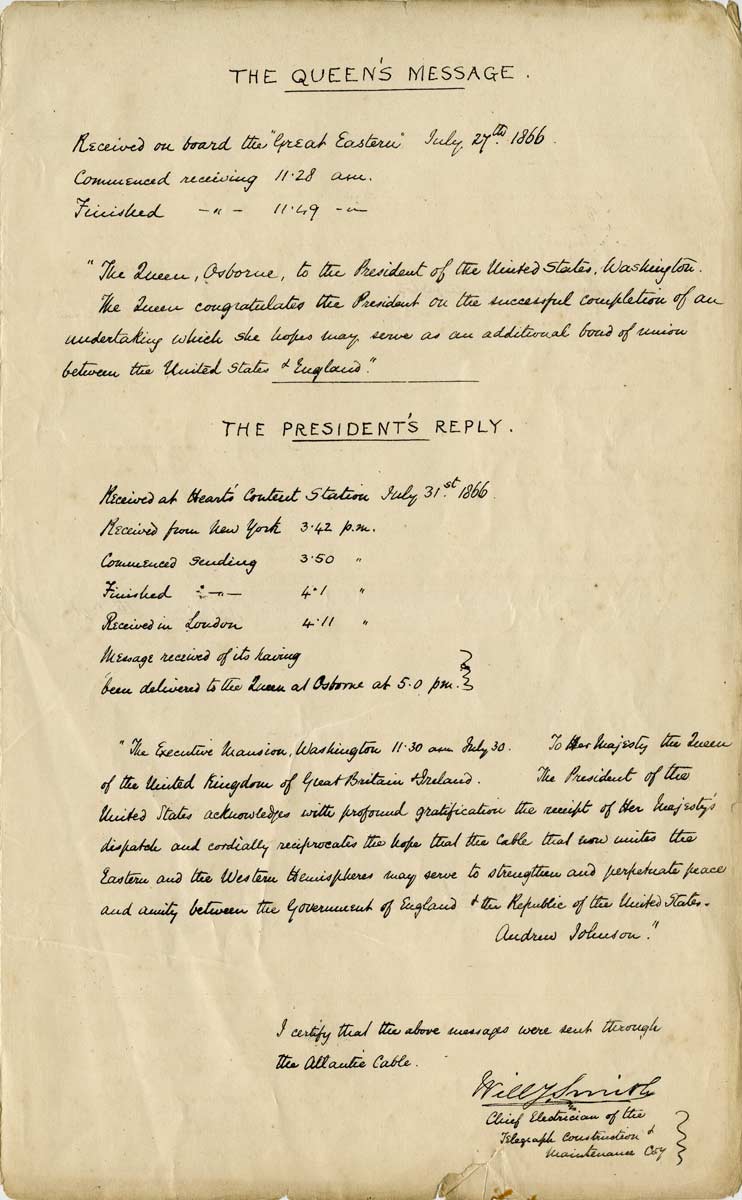
John C. Deane kept a diary of the 1866 expedition (July 12th to 27th) which was printed on board ship and subsequently published in newspapers after his return to England. Two additional pages give the text of congratulatory messages sent to Cyrus Field at Heart’s Content by President Andrew Johnson and Secretary of State William H. Seward, as well as the messages exchanged over the cable between Queen Victoria and President Andrew Johnson.
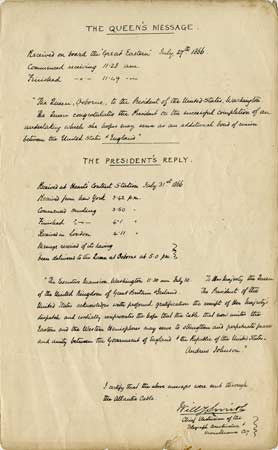
This year also had five general publications, but with more varied content than in 1865. Two issues of The Great Eastern Telegraph and Test Room Chronicle provided news of ship and shore (Saturday July 21st and Saturday July 28, together with a page reproducing the text of the messages between the Queen and the President), and a third was published at Heart’s Content on September 8th after the landing of the 1865 cable, detailing the messages received over the recovered cable. There were also playbills for two entertainments: a satirical musical entitled A Field Glass (dated July 1866 and according to newspaper reports of the time, performed on July 4th on the way from Sheerness to Ireland); and Contentina: A Comic Operetta in Three Tableaux, performed on September 17th during the return voyage to England.
A single-page document, probably published shortly after the successful landing of the 1866 cable at Heart’s Content, extends the congratulations of the Directors of the Telegraph Construction and Maintenance Company and the Anglo-American Telegraph Company to the cable staff and crew, along with “a gratuity of a month’s pay.” It also expresses their confidence “that in the more difficult task yet before them, they will display the same hearty zeal in the performance of the work.” This task was, of course, the recovery of the lost 1865 cable. The document is signed by Daniel Gooch, Augustus Hamilton, Cyrus W. Field and John C. Deane.
Publications in Chronological Order
| 1865 |
|
Title |
Pages |
|
Notes |
| 1. |
|
William H. Russell’s The Laying of the Atlantic Cable.
Diary of Events
34 pages (North American distribution), 37 pages (British distribution).
[Only the complete 37-page version
is included in the page totals for the year] |
34/37 |
|
1a |
| 2. |
|
Notice to the Reader & Printer
Corrections for both editions of the above text. |
6 |
|
1a |
| 3. |
|
Postscript for Printer and Reader
Additional corrections for the British edition. |
1 |
|
1a |
| 4. |
|
Atlantic Telegraph Expedition.
Engineers’ report dated August 16th. |
2 |
|
2 |
| 5. |
|
Five issues of The Atlantic Telegraph.
Full-page cover illustration by Henry O'Neil followed by four 4-page issues dated July 29th, August 2nd, August 12th, and August 17th.
A final 4-page section comprising two pages with illustrations by Robert Dudley (“The Night Watch” and Richard 2nd, Act 2, Scene 4); one with autographs of the cable officials, ship’s officers, and other dignitaries on board; and one with the lyrics for an Air: “The Buoy I left behind me,” noted as “Sung by Mr. Canning.” |
21 |
|
1b, 4 |
| 6. |
|
Prospectus and subscriber list dated August 1st for complete sets of The Atlantic Telegraph, priced at five shillings each, to be delivered at the end of the voyage.
No original copies of this document are known, but the “first page” of the prospectus is reproduced on page 125 of the June 1918 edition of the Telegraph and Telephone Journal.
The original document must have had at least one additional page, as the Journal’s description lists two names which do not appear on the page reproduced in the magazine.
[Editor’s note: The July 29th issue of The Atlantic Telegraph ended with: “The Atlantic Telegraph will be published till further notice. The price will be, for the series, five shillings, including the cover, and the proceeds will be devoted to such purposes as Captain Anderson shall appoint.”
[The prospectus records orders for 35 copies of the bound series from the six subscribers who signed up on its first page, and as noted above, there must have been further orders on a second page. As the listed price includes a cover, the number of orders in this format would explain why most copies of The Atlantic Telegraph found in archives are in the form of a bound volume.] |
1 |
|
3 |
| 7. |
|
21-page report on the expedition by Samuel Canning, dated 22 August 1865 at Sheerness.
In this document, addressed to the directors of the Telegraph Construction & Maintenance Company, Canning provides details of the progress of the expedition and the loss off the cable, including references to the chart and overlay described above. Canning closes with “This report has been hurriedly prepared so that the board may be placed in possession of the facts of the voyage immediately on our arrival.”
[Editor’s note: The report was evidently printed on Great Eastern’s lithographic press, as it has the characteristic look of the ink and is on white paper of the same size as all the other documents, 13" x 8.25". The only known copy of this document is in the Henry Clifford papers at the National Maritime Museum’s Caird Library.]
|
1 |
|
2 |
| |
Total pages for 1865:
(plus two charts on three 13" x 16½" sheets and an overlay) |
89 |
|
|
| 1866 |
|
Title |
Pages |
|
Notes |
| 1. |
|
Anglo American Telegraph Co. (Limited). Confidential Instructions.
Undated, but presumably printed prior to the expedition. |
2 |
|
1b |
| 2. |
|
A Field Glass - Being a Cableistic and Eastern Extravaganza.
Page count includes cover. Performed on July 4th on the voyage from Sheerness to Ireland. |
12 |
|
4 |
| 3. |
|
John C. Deane’s Diary of the Atlantic Telegraph Expedition, 1866. |
38 |
|
1c |
| 4. |
|
“Great Eastern” and Atlantic Cable. July 1866. Particulars at Noon each day; ship time.
Tables of weather positions and cable laid for July 1866. A single sheet covering all 14 days of the expedition, updated each day. |
1 |
|
5 |
| 5. |
|
The Great Eastern Telegraph 1866 and Test Room Chronicle (as shown on the title page).
Published as loose sheets and later as a bound volume. Two 4-page issues were published at sea on July 21st and July 28th, and a supplemental 4-page issue was published on September 8th while Great Eastern was moored at Heart’s Content after recovering the 1865 cable (see entry 10 below).
Each issue was printed on both sides of a sheet of foolscap paper (13" high by 16½" wide, folded in half), and a further sheet of the same size had a title page on one side and the Queen’s message and President’s reply on the other.
This sheet was laid out so when folded in half it could be used as a wrapper around the set of issues. The title page then formed the front cover, and the messages page the inside back cover. |
14 |
|
1b |
| 6. |
|
The Queen’s Message and the President’s Reply
A
different format from the version above; also includes congratulatory messages to Cyrus Field at Heart’s Content. Printed on both sides of a sheet of half-foolscap blue paper. |
2 |
|
8 |
| 7. |
|
Atlantic Telegraph Expedition 1866 - The Landing of the Shore End
The continuation of John Deane’s diary of the expedition, including the recovery of the 1865 cable. |
32 |
|
2 |
| 8. |
|
Postscript for the Reader & Printer
Corrections to the text above. |
4 |
|
1a |
| 9. |
|
Message from the Directors of Telcon and Anglo-American to “all engaged in the work of laying the Atlantic Cable”. |
1 |
|
1a |
| 10. |
|
The Great Eastern Telegraph supplemental issue.
Four pages on one sheet of blue paper. Dated September 8th; see entry 5 above for details. |
|
|
1b |
| 11. |
|
Contentina: A Comic Operetta in Three Tableaux
Page count includes cover and contents page. Performed on September 17th during the return voyage to England.
|
12 |
|
5 |
| |
Total pages for 1866: |
118 |
|
|
| |
Total pages for both years:
(1865 charts not included) |
207 |
|
|
Notes on document sources: 1a-BB/TT, 1b-BB/BH, 1c-BB/JH, 1d-BB/VT, 2-NMM, 3-TTJ, 4-Various, 5-IET
Surveying all the known documents, it appears that official publications such as instructions and other communications issued by the company, as well as the expedition diaries, were printed on blue paper, while most (but not all) copies of the shipboard newspapers and the scripts for the two musical sketches used plain paper.
Unless noted otherwise above, the diaries and other official documents were printed with two pages side by side on just one side of a sheet of paper measuring 13" high by 16½" wide, approximately the size commonly called foolscap. This was then folded to make two pages back to back, each 13" x 8¼" or foolscap folio, with the inner sides blank. These are sometimes found split into single pages with a blank reverse.
Issues of the newspapers published in 1865 (The Atlantic Telegraph) and 1866 (The Great Eastern Telegraph 1866 and Test Room Chronicle), as well as the programmes for the musical performances in 1866 (A Field Glass and Contentina), were printed in the same format, but on both sides of the full-size foolscap paper.
The foolscap paper size used on Great Eastern in the 1860s is now the de facto metric paper size F3, which is 330 mm × 420 mm (13 in × 16½ in). When folded this becomes F4, a slightly longer version of A4, 210 mm × 330 mm (8¼ in × 13 in). |